To decide what a user should do next, identify their current situation and immediate goal, list useful interventions, and compare expected benefit with effort and risk. Choose the smallest helpful action, including doing nothing, then test whether it improves task completion without increasing frustration, unwanted messages, or loss of trust.
A next-best action is a context-specific recommendation or intervention that helps a user make progress toward an immediate goal. This guide is for product managers and PM interview candidates deciding when a product should recommend, remind, offer help, or stay quiet.
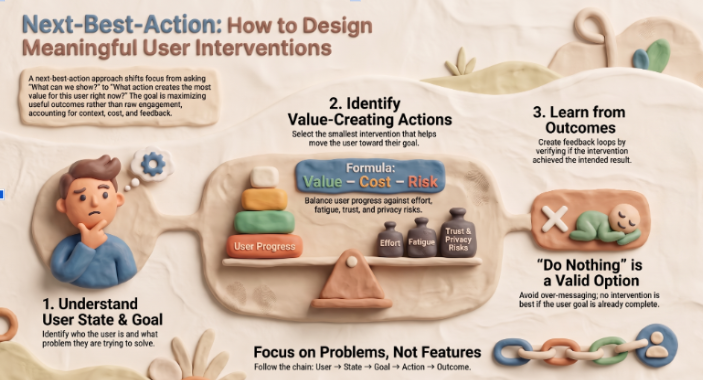
A practical guide to next-best actions: making the right intervention for the right user at the right moment—and recognizing when doing nothing is best.
Next-best-action design focuses on meaningful user interventions, not simply more engagement.
What does the user need right now?
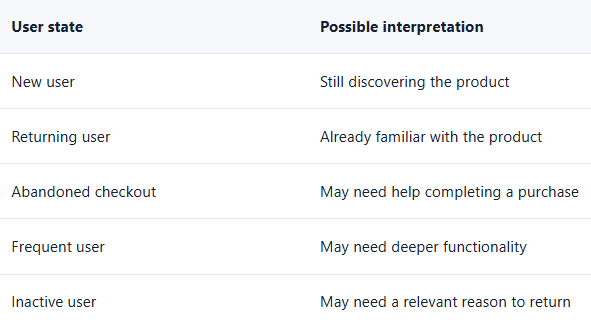
Imagine two people opening the same app. One user is browsing for the first time. Another has already added something to their cart. A third user tried to complete an action yesterday but couldn’t.
Should all three see the same message? Probably not. Why do so many digital products treat every user as if they have the same needs at the exact same time?
A good product doesn’t just ask, “What can we show the user?” It asks:
“Given what we know about this user right now, what action would create the most value?”
This is the basic idea behind a next-best-action approach.
What is a next-best action in product management?
In product management, a next-best action is the most useful intervention a product can recommend or perform for a specific user at a specific moment. Think of it like an attentive waiter in a restaurant. A great waiter doesn’t blurt out the dessert menu while you’re still reading the appetizers, nor do they interrupt every two minutes to ask how your water tastes. They observe your context, anticipate your goal, and intervene only when it adds delight or resolves a problem.
Depending on the context, a next-best action could be:
- Showing a recommendation when a user is actively exploring.
- Sending a reminder when a user gets distracted mid-task.
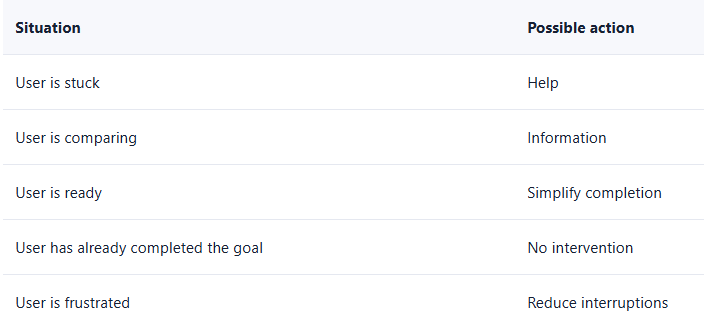
- Offering proactive help when a user exhibits signs of being stuck.
- Asking for missing information required to complete a setup.
- Suggesting an alternative when a chosen product is out of stock.
- Doing nothing at all.
Why “do nothing” matters: Products that constantly pester users with notifications might see a brief spike in daily active users, but can build long-term fatigue, frustration, and app uninstalls. The goal is not mindless activity; it is useful, valuable outcomes.
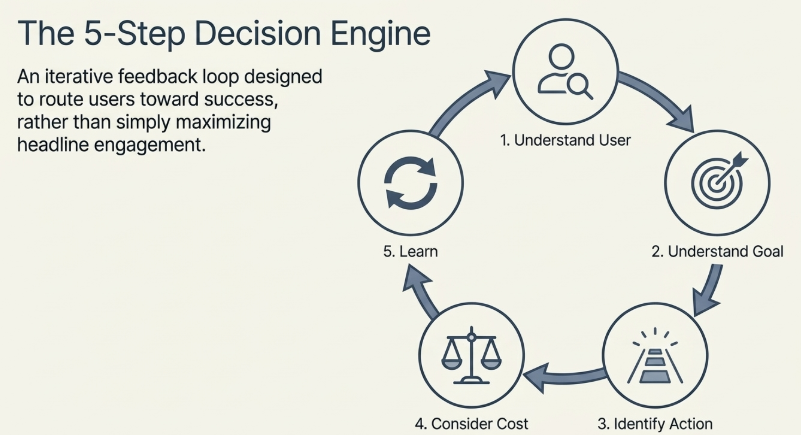
How do you choose a next-best action in five steps?
When answering a product interview question about personalization or next-best actions, use this structure.
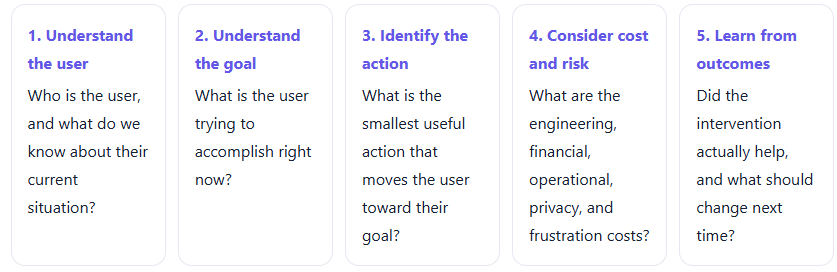
1. Understand the user
Ask: Who is this user and what do we know about their current situation?
2. Understand the user’s goal
Shift focus from business goals to the user’s immediate problem. If someone leaves an item in their cart, is their goal to resolve a payment issue, compare alternatives, or learn more about product details? Different goals require drastically different solutions.
3. Identify the value-creating action
Ask: What is the smallest action that could move the user toward their goal?

The product isn’t successful just because it showed an alternative. It is successful if that alternative helps the user complete the intended task.
4. Consider cost and side effects
Every intervention carries hidden costs—including engineering effort, financial expense, operational load, compliance risk, and user frustration. A smart product decision maximizes:
Expected Value − Cost − Risk
It should not simply chase maximum engagement.
5. Learn from the outcome
Personalization relies on a continuous feedback loop:
Recommendation → User Action → Outcome → Learn → Better Recommendation
A system must measure whether an intervention truly worked so it can refine future suggestions.
How should you explain next-best actions in a PM interview?
In product management interviews, candidates are frequently tested with scenario questions such as: “Design a personalized reminder system for an e-commerce application.”
- A weak answer jumps straight to tactical features: “I would send push notifications to inactive users.” This response falls into classic product-management traps.
- A strong answer steps back and asks diagnostic questions first:
- Who counts as an inactive user?
- What action do we want them to take, and why would a reminder help?
- When should the reminder be sent?
- How do we know the reminder worked?
- What negative side effects, such as notification fatigue or privacy concerns, should we monitor?
The important part isn’t the notification. The important part is the decision behind the notification.
Does personalization always mean sending more messages?
Personalization does not mean “send a different notification to everyone.” It means choosing the right intervention—or choosing not to intervene—based on the user’s situation.
Which mistakes should you avoid in a PM interview?
- Starting with features. Building an AI recommendation engine before identifying the user’s actual friction point leads to unnecessary complexity.
- Optimizing for engagement only. More clicks or page views do not necessarily mean higher user satisfaction or business value.
- Ignoring the “do nothing” option. Bombarding users who have already achieved their goal damages brand trust and goodwill.
What should you remember about next-best actions?
- The 5-step sequence: Progress systematically from User → State → Goal → Action → Outcome.
- Problem-first design: Diagnose user context before proposing technical solutions.
- Focus on value over engagement: The primary objective is useful user outcomes, not raw click volume or message frequency.
Remember: The best next action is not always another message or recommendation. It is the action—or deliberate non-action—that best helps the user achieve their goal.
Next-best action vs. next-best offer: what changes?
| Decision | Next-best action | Next-best offer |
|---|---|---|
| Purpose | Help the user reach an immediate goal | Choose a relevant commercial proposition |
| Options | Help, recommendation, reminder, or no intervention | Product, upgrade, or discount |
| Checkout example | Explain a payment error before asking the user to retry | Offer a relevant discount when price is the obstacle |
What evidence should guide your decision?
Use research to frame the decision, then test your own hypothesis. Nielsen Norman Group’s usability heuristics recommend keeping users informed, supporting user control, and making errors recoverable. Applied here, explain why you suggest an action and make it easy to decline.
Kohavi and colleagues’ Online Controlled Experiments at Large Scale describes experimentation and challenges to trustworthy results. For your decision, define success and guardrails before comparing an intervention with a control.
PMMockr is an AI mock-interview platform for product managers who want to practice interview answers and receive feedback. You can practice explaining your next-best-action decision with a user goal, tradeoffs, and a measurement plan.
What else should you know about next-best actions?
What is a next-best action?
A next-best action is the most useful intervention for a particular user in their current context. It can be a recommendation, reminder, help prompt, or a deliberate decision to leave the user alone.
How do you identify the user’s immediate goal?
Combine the current task, recent behavior, explicit preferences, and research. Treat behavioral signals as hypotheses: a paused checkout could mean a payment problem, comparison shopping, or a decision to stop.
How is next-best action different from next-best offer?
A next-best offer selects a commercial proposition, such as an upgrade or discount. A next-best action considers a wider set of interventions, including support, setup guidance, and no intervention.
When should a product do nothing?
Choose no intervention when the user is progressing independently, has completed the task, declined contact, or would face more interruption than benefit. Include this option when comparing possible actions.
Do you need AI to choose a next-best action?
No. Start with explicit rules for clear situations, such as offering payment help after an error. Consider a model when context and candidate actions become too varied for maintainable rules, and validate it against a simpler baseline.
Which metrics should you use?
Choose a goal metric such as successful task completion, then monitor guardrails such as errors, opt-outs, complaints, and retention. A higher click rate alone does not establish that an intervention helped.
How do you test whether an intervention helps?
Compare eligible users randomly assigned to the proposed intervention and a suitable control. Define the outcome, guardrails, and analysis plan before testing; check data quality and uncertainty before making a rollout decision.
How should you answer a next-best-action PM interview question?
Clarify the user segment, situation, and goal. Compare candidate interventions with doing nothing, explain your tradeoffs, and describe an experiment with an outcome metric and guardrails. State assumptions instead of inventing impact estimates.
Who wrote this guide?
Julliet Mohanta is an aspiring product manager from IIT Kharagpur and the author of this PMMockr guide on next-best-action decisions.
What changed in this guide?
: Added a direct answer, question headings, a comparison, research references, author context, and eight FAQs. Original publication date retained.